
Pregnant again: the unseen life of lab mouse mothers
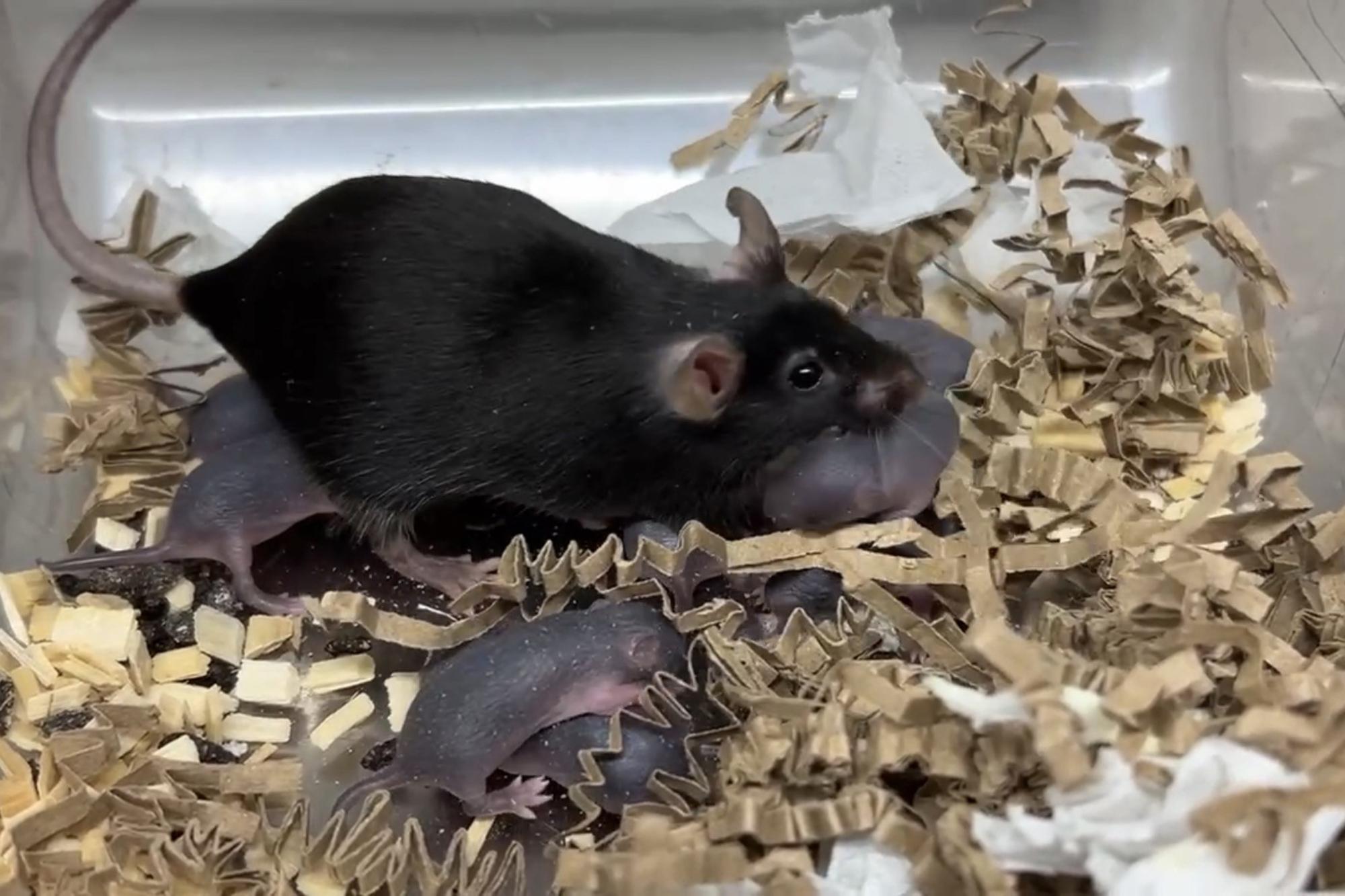
Female lab mice can become pregnant again within 24 hours of giving birth. Christina Boyle asked what that relentless cycle actually does to their wellbeing — and found something surprising.
In Switzerland, more than 346,000 mice were used in research in 2020 - and behind every litter of lab mice is a mother whose own health rarely gets a second look. Christina Boyle is researcher at the University of Zurich and leader of the NRP 79 project "Caring for the mothers: the impact of breeding on female mice" This project could be the first systematic study into how breeding affects mothers' wellbeing.
What actually happens inside a female mouse's body when she's bred again just hours after giving birth?
It’s called postpartum oestrus. Within 24 hours of giving birth, her body releases eggs again, and if a male is there – which is often the case in a breeding cage – she can become pregnant again within that same window. Since gestation and lactation each last about three weeks, she then spends the next three weeks gestating a new litter while nursing the one she just had. Pregnancy alone is already associated with a high metabolic demand, lactation even more; together, they place a considerable physiological burden on the mother, over months.
You call these mother mice "the unsung workhorses of animal research". Why has their welfare been overlooked until now, and what made you realize that nobody had really studied this before?
Breeding has simply been done the same way for decades, and it happens behind the scene for most researchers – on a different floor or outsourced to a breeder. So most researchers are largely unaware of the details and have little reason to question it. The idea to study the mothers came from an animal welfare conference, where the focus was on how breeding practices can impact the offspring, but there was no discussion about the mothers. When I looked for evidence that breeding mothers were fine, I couldn't find it: plenty of studies use mice as models for human pregnancy and lactation, but almost none look at the breeding mouse herself.
Your project looks at mothers' behaviour, metabolism, and nutrition. What were the key indicators you used to determine if a mouse mother is struggling?
That was one of the biggest challenges: since no previous research on the subject existed, there was no predefined welfare checklist to work from. We started from ground zero: We looked at metabolism and tracked weight gain, fat mass, and glucose handling. We also looked at skeletal health, since pregnancy and lactation place high mineral demands on the body: bone volume dropped after the first pregnancy and further after four, though never to the point of fracture. Finally, we assessed her stress levels non-invasively by measuring stress hormone metabolites in her faeces.
Can you tell me something about the collaborations you had during the project?
We had several collaborations that were particularly important for this project. First, we worked alongside a biostatistician from the Office for Animal Welfare and 3R at University of Zurich, to choose the right statistical approach. We worked with a collaborator who could measure corticosterone metabolites directly from faeces, which let us track stress non-invasively over time instead of relying on blood samples. And finally, we partnered directly with commercial breeders, testing whether retired mouse mothers from their breeding colonies exhibited similar profiles to mothers in our exploratory study. They largely did.
Does what happens to the mother also affect her pups – and could that effect build up over several litters?
While we are still investigating some aspects, we didn't see much of a difference in the pups. There's a slight difference in size at birth, but they catch up and even months later, they appear similar, regardless of the mother's breeding history. We also measured how mouse pups communicate with their mother and that was identical too, whether the pups were born to a first-time mother or a fourth-time mother. We plan to look more closely at the pups' bone volume in the coming months, to see if it's related to the drop in bone volume we saw in the mothers after repeated pregnancies.
After all these years of research, what would you want to see change in labs?
I don't think we need a dramatic call to arms, just more awareness. If you're breeding animals yourself, think about the mothers, and maybe retire females at the first signs of declining litter size rather than pushing further. We're not ready for strict guidelines, the evidence isn't there yet. But presenting our results at a major laboratory animal science conference and seeing breeders get excited and talk about it, was probably the biggest outcome so far. We also now have a solid dataset that can serve as a baseline for future guidelines.
In terms of reduction, could better breeding guidelines also mean fewer animals for research?
Yes, this shift is already happening for other reasons too. The push to reduce surplus animals is changing how breeding is done in general. Until now, permanent pairing was standard: one male and one female stay together long-term. This puts the most pressure on the female, but it also produces the most litter. Researchers have long valued that, since it reliably delivers experimental animals every three weeks. But it's becoming clearer that some of these animals are never actually used in experiments. That's why "timed breeding" is becoming more popular: the male stays with the female only briefly, then is reintroduced later. This way, pregnancies and nursing periods no longer follow one another back-to-back. Since we've started presenting our results, we're already hearing that labs are reducing permanent breeding pairs.
What's been the most surprising thing you've learned so far about how these mother mice are actually doing?
Two findings surprised me most. The first was just how resilient they are. We expected some physical decline, and did see some, notably in terms of bone density, though never to the point of fracture. But stress hormones didn't increase, and their motivation to care for their pups stayed just as strong even after four cycles. The second surprise was that quite a few females could not sustain a fourth pregnancy. This could be a built-in protection mechanism: if a mother’s body doesn't have the reserves, pregnancy will not occur.
Your project is officially ending this October. What happens next, and what do you hope for the future?
After the end of the project, we’ll spend an additional six months finalising the analysis and aim to publish the findings during this period. Beyond that, I’d be interested in exploring the positive side of reproduction. We tend to frame pregnancy and lactation only as physiological challenges, but research in rodents and women shows that maternal behaviour also activates reward pathways in the brain. It would be fascinating to test whether the maternal experience itself represents a form of enrichment for these mice.